AFTER THE FLOOD
January 17 – February 7, 2004
- By Randy Baker
- Directed by Jeremy Skinner & James Hart
- World Premiere
- THE SANCTUARY THEATRE at Casa Del Pueblo Calvary Methodist Church
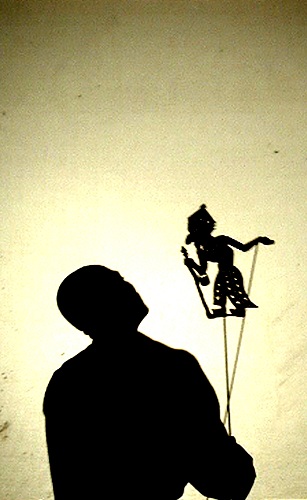
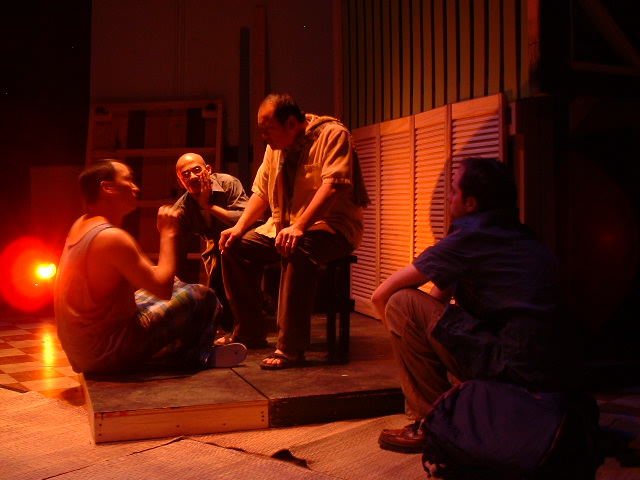
Ethan Brooks, an American academic and a skeptic, returns to South East Asia, where he grew up, to study the dying art form of Malay shadow puppetry. Questions emerge surrounding the disappearance of one of the few remaining puppet masters, and Brooks sets off to find answers in the remote villages of Malaysia. The fables of the old puppeteer begin to mingle with Brooks’ story as he searches and begins to reconcile his own shadows.
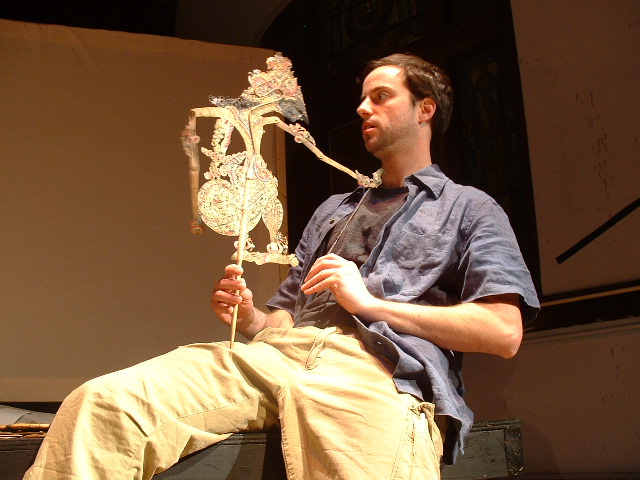
In alternating scenes an actual shadow puppet play intersects with the modern narrative. Based loosely on the Hindu epic The Ramayana, it tells of a great battle that will bring either the birth of a hero or the death of a legend.
AFTER THE FLOOD was sponsored in part by Pete Miller & Sara Cormeny.
FEATURING
Anne Bowles
Frank Britton
Franklin Dam
Jennifer Knight
Jason Lott
Scott McCormick
Josh Skidmore
Meg Taintor
Al Twanmo
Paul MacWhorter
Designers
Set Design Matt Soule
Lighting Design John Burkland
Costume & Puppet Design Debra Kim Sivigny
Asst. Costume Design Frank Labovitz
Sound Design & Composer David McKeever
STAFF
Stage Manager Jordan Sudermann
PRODUCERS
Randy Baker
Jenny McConnell Frederick
PRESS
Rorschach, Shedding light on Shadow Puppetry
By Jane Horowitz
Washington Post
January 20, 2004
“I’ve been talking about it in bars for a long time,” says Randy Baker of “After the Flood,” his play about a Westerner on a spiritual/romantic/coming-of-age quest in Malaysia who encounters wayang kulit, the mystical art of shadow puppetry. So ambitious were his ideas of blending human actors and puppetry that a few years went by before Baker and his co-artistic director at Rorschach Theatre, Jenny McConnell, saw their way to getting it produced.
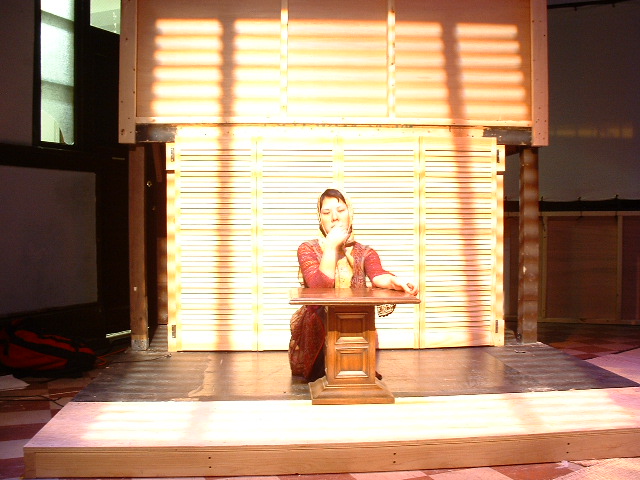
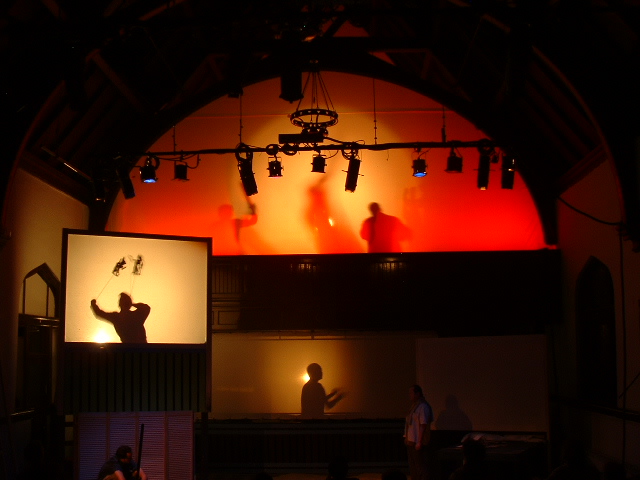
The small but ambitious experimental company premiered Baker’s play on Saturday and will run it through Feb. 7 at Casa del Pueblo (1459 Columbia Rd. NW). “After the Flood” is a huge undertaking for shoestring-budgeted Rorschach. It tells parallel tales, one human and one a puppet fairy tale. The playing space contains large white screens for the shadow puppets. Backgrounds are projected onto the same screens when human characters take the stage.
Costume and puppet designer Debra Kim Sivigny, scenic designer Matt Soule and sound designer-composer David McKeever traveled to Asia for inspiration. (It helps that playwright Baker also works as a travel agent.) Original puppets were created for “Flood.” McConnell says that despite the mass of details and expense, she knew that “somehow we would figure out how to do it.” Adds Baker, “We jump off a cliff and hope.”
Baker, 29, grew up in Singapore and Malaysia, where his scholarly parents remain and where his paternal grandparents were once missionaries. He repatriated in 1992 to attend the University of Richmond. The play’s protagonist also is an American who grew up in Malaysia and returns to do research on puppetry and, perhaps, to reconnect with a former girlfriend. He hears that a master puppeteer has disappeared, and rumor has it the man simply rose to heaven.
The stories told in wayang kulit are based mostly on Hindu legend, Baker explains, and a master puppeteer can be viewed as “sort of a priest.” He says he’s tried to avoid an urge to lecture his audience, to let the play become merely a travelogue to introduce Westerners to a new culture.
McConnell says they wanted the play to give “this sense of a third-culture kid.” Adds Baker, “the feeling of not belonging — a very familiar sense of alienation.” He says that “writing this play has been about paring down a lot of this . . . and making it about one character’s journey and not an educational biopic.”
Even so, co-director Jeremy Skidmore (of the Theater Alliance) says, “I think most audiences are going to find it completely unique . . . for anyone who hasn’t spent time in Asia. . . . People are going to learn so much.” Skidmore has teamed with James Hart, whom he met in Taiwan in 2000. Skidmore was organizing a theater festival there and Hart was on a fellowship to study ritual masks and dancing, and added puppetry to his research.
He taught four Rorschach actors how to operate the delicate silhouette cutout creations, “how to animate the puppets so they give the illusion of being alive, so they breathe.” The trick: close to the screen for smaller, sharper images, farther back for a bigger, softer-edged view. “I love that there are several different stories that are occurring at once . . . two plays in one,” says Hart, “both of which are epic in proportions.”